In Spain, about 2.5 million people suffer from depression and another 2 million from anxiety.
There are effective treatments available for established depression and anxiety, but to prevent new cases from developing, prevention is the best option.
The Research Network on Chronicity, Primary Care, and Health Promotion and Prevention (RICAPPS), through its Mental Health, Services, and Primary Care group (SAMSERAP) of the Biomedical Research Institute of Malaga and the Nanomedicine Platform, IBIMA BIONAND Platform, and the Biomedical Research Institute of Salamanca (IBSAL) , is launching a preventive intervention (PANDORA : Prevention of Anxiety and Depression Over Risk Assessment : a randomized controlled trial ) for anxiety and depression , implemented via a mobile app . To this end, 2,600 people aged 18 to 65 without significant depression or anxiety will be recruited in Spain and Chile.
According to Juan Bellón, the project’s principal investigator, “we will assess whether a personalized digital intervention delivered via mobile phone can reduce new cases of common mental disorders and their significant social and economic impact; and the fact is that we know treatments only reduce the disease burden ( years lived with a poor quality of life) of depression and anxiety by between 30% and 50% , respectively. This is partly because, of the total number of depression and anxiety cases in a given year, more than 40% are new cases, and treatments do little or nothing to prevent these new cases from occurring.” “To that end, prevention is the answer. We now know that preventive psychological and psychoeducational interventions, along with physical exercise, prevent between 20% and 40% of new cases of depression and anxiety from developing.”
In fact, today more than 90% of adults own a cell phone and use it to access the internet. Therefore , it is highly likely that the PANDORA initiative could reach many millions of people in Spain and South America.
Depression and Anxiety in Spain
Depression and anxiety are the most common mental illnesses. In Spain, about 2.5 million people suffer from depression and another 2 million from anxiety. In 2021, depression and anxiety—among all physical and mental illnesses—ranked second and eighth worldwide in terms of years lived with a poor quality of life, and it is estimated that by 2030, depression will rank first. Recurring thoughts of not wanting to live are common among people with depression, and nearly one million people worldwide take their own lives each year.
But their impact goes beyond health. Depression and anxiety are more common among working-age adults and are among the conditions that result in the most sick leave, which tends to be very prolonged. People with depression and anxiety perform less effectively at work and face significant difficulties finding or keeping a job. As a result, depression and anxiety cost Spain 12,000 million euros annually.
The PANDORA Project
Participation in the PANDORA study is currently open to any citizen of Spain or Chile. To participate in the PANDORA study, visit the study’s official website at https://pandorasalud.org/
The study will follow all participants for one year, monitoring the incidence of new cases of depression and anxiety. Participants will be randomly assigned to three groups: two intervention groups and one control group, to evaluate the PANDORA intervention.
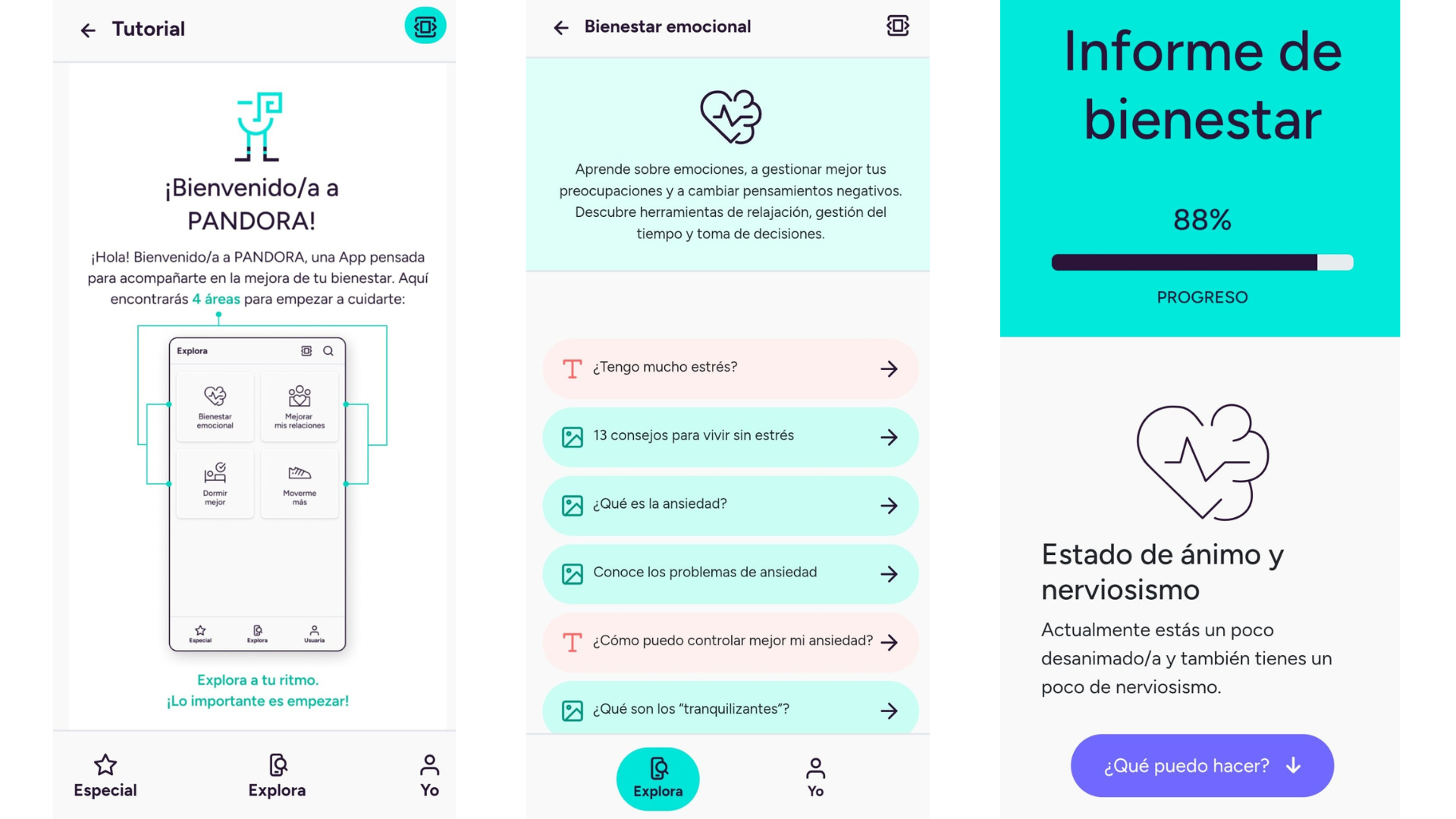
The PANDORA intervention will be delivered through an app (available for Android and iOS) and includes tips and exercises from four intervention groups that have been scientifically proven to be effective in preventing anxiety and depression: “get more active,” “sleep better,” “improve relationships,” and “improve emotional well-being.” It will also include calculators to predict the risk of developing depression and anxiety over the next 12 months. Assessments of depression and anxiety prevention will be conducted monthly, as well as at 6 and 12 months.
The app will also identify the risk factors for depression and anxiety present in each person, highlighting those that could be addressed for prevention, and will automatically and personally recommend the app content that would be most useful to the user in their specific situation.
Users implement this plan based on their motivation and availability, and the PANDORA app tracks and reports on their progress and suggests new actions when the risk of depression and anxiety increases. The app also allows users to filter its content by topic, priority within the personalized prevention plan, duration in minutes (from 2 to 10 minutes), and format (text, videos, “trivia,” exercise, etc.).
“There are two versions of PANDORA,” explains Juan Bellón, a researcher at RICAPP and the project coordinator; both have the same content but are organized differently. “In addition, some users may also be randomly assigned to the comparison group. This group of people is very important and essential for determining with certainty whether the PANDORA intervention prevents depression and anxiety compared to the comparison group.”