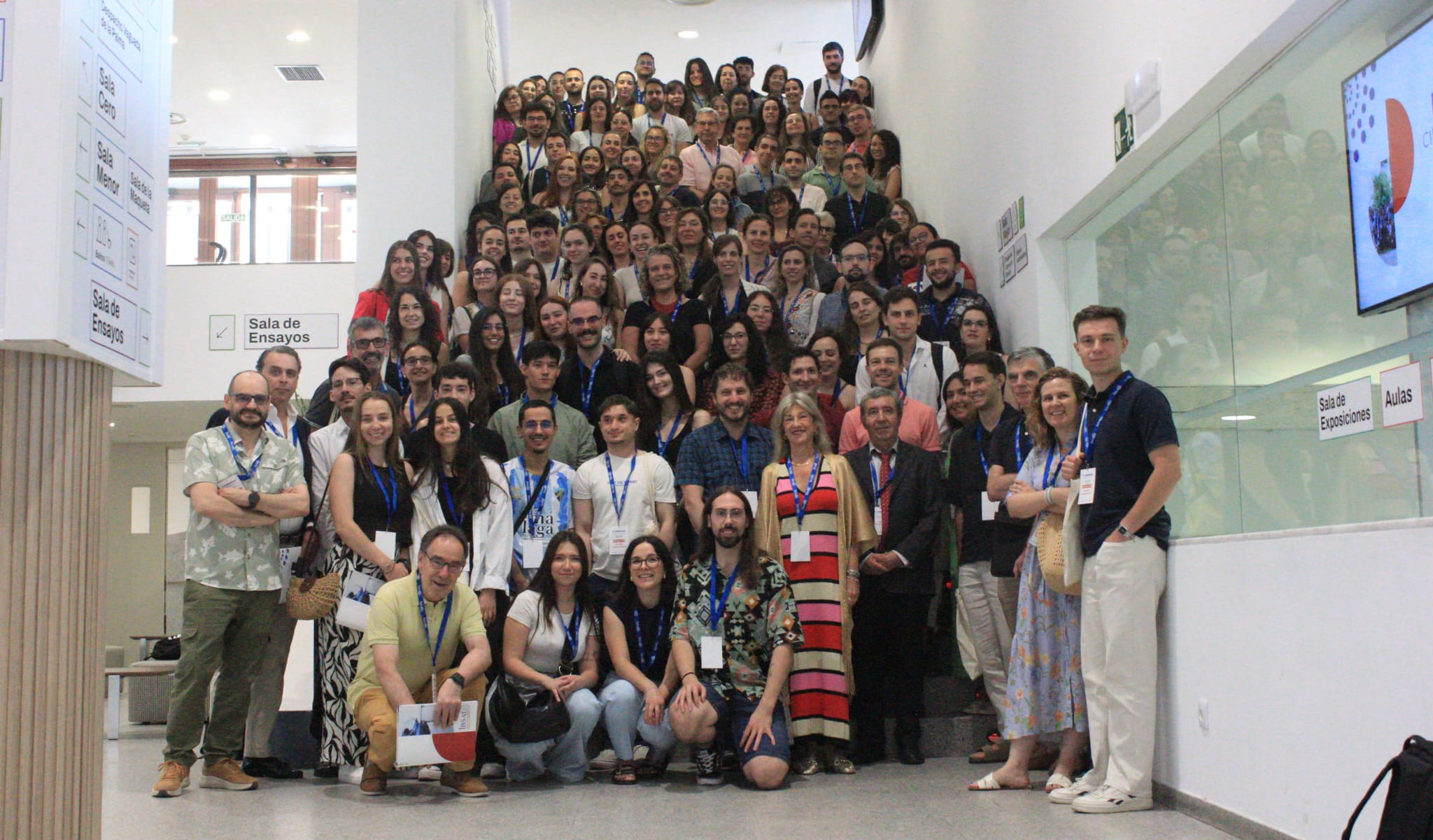
Luis García Ortiz, scientific director of the Salamanca Institute for Biomedical Research, highlighted the efforts of the research and management teams during the 4th Scientific Conference, which brought together 300 participants at the Castilla y León Exhibition and Convention Center.
Martín Gómez Redondo, speaking on behalf of the pre-doctoral researchers, emphasizes that this event “highlights the enormous daily effort behind the knowledge we generate” and describes it as “an essential opportunity to grow as scientists.”
The Salamanca Biomedical Research Institute (IBSAL)—the Department of Health of the Regional Government of Castile and León, the University of Salamanca (USAL), and the Spanish National Research Council (CSIC) — closes out 2024 with an outstanding record of scientific, educational, and administrative activity, including 632 scientific publications, 114 new competitively funded projects, 107 new clinical trials, and 89 doctoral dissertations defended—figures that solidify its position as a leader in biomedical research.
During the opening ceremony of the 4th Scientific Conference, IBSAL’s scientific director, Luis García Ortiz, noted that “2024 has been a year of intense activity and changes at the institute, both in management and in scientific areas. “We have all worked hard to implement the changes recommended in the recent reaccreditation” as a health research institute by the ISCIII, which was granted in February 2024 for a period of five years.
In this regard, he wished to acknowledge the collective effort of the 1,422 people who make up IBSAL: “I would like to thank everyone for their work in bringing about these changes—including management staff, department coordinators, platform managers, committee coordinators, and all researchers—for their hard work and for their excellent reception of the changes implemented, which have allowed us to adapt to the institute’s new requirements.”
In the area of training, IBSAL has organized 30 courses, 31 seminars, and 17 workshops, in addition to 28 courses and one workshop held in collaboration with other organizations with the University Hospital of Salamanca. A total of 59 have also been conducted research stays.
Of the 114 competitive projects, 82 are managed directly by IBSAL, representing a 32% increase from the 62 projects in the previous year. In total, the institute has 254 active projects, with 170 under its direct management. In the area of clinical research, 107 new clinical studies have been launched (86 clinical trials and 21 observational studies). This brings the total number of active studies to 581: 450 clinical trials and 131 observational studies.Regarding scientific output, of the 632 total publications, 594 are original articles and reviews, of which 23% appear in Decile 1 (D1) journals, 64% in the first quartile (Q1), and 17% in the second quartile (Q2), demonstrating the high impact of the research conducted, with more than 80% of its publications appearing in high-impact journals worldwide.
The 4th Scientific Conference, which brings together 300 researchers at the Salamanca Convention and Exhibition Center, kicked off with the Young Researchers’ Meeting and an exhibition of the eight papers selected from among the 73 submitted by the Institute’s trainees, of which another 40 were presented in poster format.
In his welcome address, Luis García Ortiz also highlighted the involvement of younger researchers, who “through the Predoc Community, are demonstrating how well they have integrated into the institute, as well as their excellent preparation, as evidenced by the quality of the papers presented at this conference.” He also highlighted the new format of this year’s conference, “through which we have sought to bring together young and senior researchers to foster collaboration among them and leverage the expertise of the three guest speakers to explore the topic of open science in greater depth.”
Later, Martín Gómez Redondo, a representative of the pre-doctoral researchers, stated that “this event is essential for researchers like us who are in the early stages of our careers, as it allows us to share our research and our first steps in science. It helps us grow as scientists, learn from other researchers, and highlight the enormous daily effort behind the knowledge we generate.”
Alba Torres Valle, Enrique Jiménez Madrona, María Martínez Fernández, Joana del Valle Mercado Hernández, Lucía Fernández Frías, Araceli Sama Barroso, Yoan Reynaldo Torres Cruz, and Sara María Vicente Gabriel have presented oral presentations on their work covering a variety of highly topical scientific subjects within each of IBSAL’s research areas: Cancer; Cardiovascular, Renal, and Respiratory Diseases; Neuroscience; Infectious, Inflammatory, and Metabolic Diseases; Gene and Cell Therapy and Transplants; and Primary Care, Public Health, and Pharmacology.
Following the official opening of this 4th Scientific Conference, attended by Sonia Martín Pérez, Director General of Health Planning, Research, and Innovation for the Regional Government of Castile and León, and José Miguel Mateos Roco, Vice Rector for Research and Technology Transfer at the University of Salamanca, as well as Luis García Ortiz, who presented the Institute Report for the year 2024, some of the the most notable projects at the national level, coordinated by IBSAL, such as the Diagnostic and Therapeutic Approach to Renal Fragility; the UMBRELLA-SUMMA Legacy to improve the management of myelodysplastic syndromes; and the clinical trial on CARTemis-1 to treat patients with relapsed multiple myeloma. Similarly, the Institute’s support platforms will be presented during the conference, including those for Clinical Epidemiology and Methodology, REDCap, Bioinformatics, Clinical Trials, Biomodels, and Biobanks.
The planned agenda is rounded out with a roundtable discussion on the National Science Strategy and Research Evaluation moderated by Ángeles Almeida, deputy scientific director of IBSAL, with the participation of Pilar Rico Castro, head of the Open Science Unit at FECYT; Paula Adam Bernad, Director of the Research Laboratory at the Catalan Agency for Health Quality and Assessment (AQuAS); and Pilar Gayoso Diz, Deputy Director General at the Carlos III Health Institute, who will also be responsible for closing the 4th IBSAL Scientific Conference this afternoon.
IBSAL
The Institute of Biomedical Research of Salamanca (IBSAL) was established on March 21, 2011 through an agreement signed by the Ministry of Health of the Regional Government of Castilla y León and the University of Salamanca, which was joined in February 2012 by the Spanish National Research Council (CSIC). It integrates and coordinates the biosanitary research carried out at the University Hospital of Salamanca, the Primary Care Management of Salamanca and the biosanitary area of the University of Salamanca, including the Institute of Neurosciences of Castilla y León and the Institute of Molecular and Cellular Biology of Cancer.
Its scientific activity is organized into six areas, comprising a total of 85 research groups: Cancer (23 groups); Cardiovascular, Renal, and Respiratory (11); Neuroscience (12); Infectious, Inflammatory, and Metabolic Diseases (19); Gene and Cell Therapy and Transplants (6); and Primary Care, Public Health, and Pharmacology (14).
More information and contact details:
comunicacion@ibsal.es