During the first year of the COVID-19 pandemic, mortality rates were particularly high among people over the age of 70, at a time when vaccines were not yet available and the causes of this high vulnerability were unclear. Now, a multidisciplinary study led by researchers from the Biomedical Research Networking Center for Respiratory Diseases (CIBERES) and the Salamanca Biomedical Research Institute (IBSAL), funded by the TV3 Marathon Foundation and the CIBERES-UCI-COVID project, provides an explanation for this phenomenon.
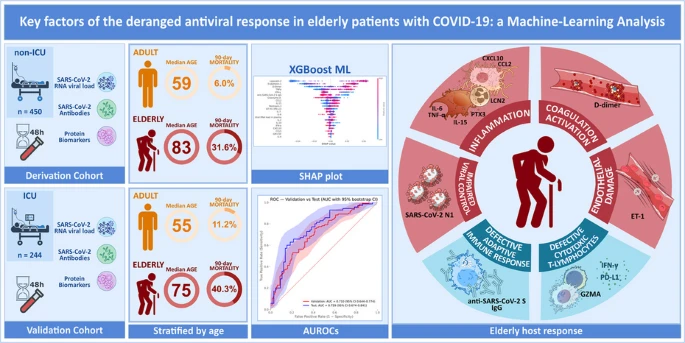
The study, published in the scientific journal GeroScience and which also involved collaboration with, among others, the Infectious Diseases unit of CIBER (CIBERINFEC), analyzed the response to SARS-CoV-2 in 450 patients admitted to the Arnau de Vilanova and Santa María de Lleida University Hospitals and the Río Hortega University Hospital in Valladolid, and validated its results in an independent cohort of 244 critically ill patients.
Reduced antiviral efficacy in older adults
The results show that people over the age of 70 developed a less effective immune response to the virus. Specifically, they produced fewer SARS-CoV-2-specific antibodies and had reduced levels of key molecules involved in antiviral defense, such as granzyme A and interferon gamma. This reduced ability to respond resulted in poorer control of the virus, with higher levels of viral load in the blood.
In addition, the study found that older adults activated immune mechanisms that differed from those of younger adults. In older adults, there was greater activation of the innate immune system, along with endothelial damage and activation of the coagulation cascade.
This pattern suggests that, in their attempt to control the infection, older adults developed a thrombo-inflammatory response associated with more severe clinical forms of the disease. As a result, mortality was significantly higher in this group: approximately 32% among those over 70 years of age, compared with 6% among younger patients.
According to Alejandro Álvaro-Meca, a researcher on the study at CIBERINFEC at Rey Juan Carlos I University in Madrid, “this biological profile was identified through the application of a machine learning model that made it possible to detect the key biomarkers associated with the response in older adults.” The model was subsequently validated in an independent cohort of critically ill patients, confirming its robustness.
Tamara Postigo-Casado, the study’s lead author and a researcher at IBSAL, notes that “this study helps us understand how older adults respond to a new virus—one against which they had no prior immunity—and provides important insights for better protecting this population against future emerging infections.”
For their part, the project’s principal investigators, Jesús F. Bermejo-Martín and David de Gonzalo—researchers at CIBERES at IBSAL and IRBLleida, respectively—emphasize that the availability of vaccines radically changed this scenario: “Once vaccinated, older adults were better able to control the virus and prevent the development of this thrombo-inflammatory response, which significantly reduced mortality.”
For his part, Raúl López-Izquierdo, the second-to-last author of the study and a researcher at Río Hortega University Hospital, highlights the collaborative model of the Spanish healthcare system: “This study demonstrates that cooperation between clinical and basic researchers is essential for better understanding serious infections and improving patient care.”
This study is part of the CIBERUCICOVID project of CIBERES, co-funded by the ISCIII’s COVID-19 Fund, which investigates personalized prognostic risk factors and one-year follow-up of patients admitted to Spanish intensive care units who are infected with the SARS-CoV-2 virus.
Article reference:
Postigo-Casado T, Ortega A, Álvaro-Meca A, Vélez-Serrano D, García-Mateo N, Tedim AP, et al. Key Factors in the Dysregulated Antiviral Response in Elderly Patients with COVID-19: A Machine-Learning Analysis GeroScience. Apr 22.
Original source of the news: CIBER ES