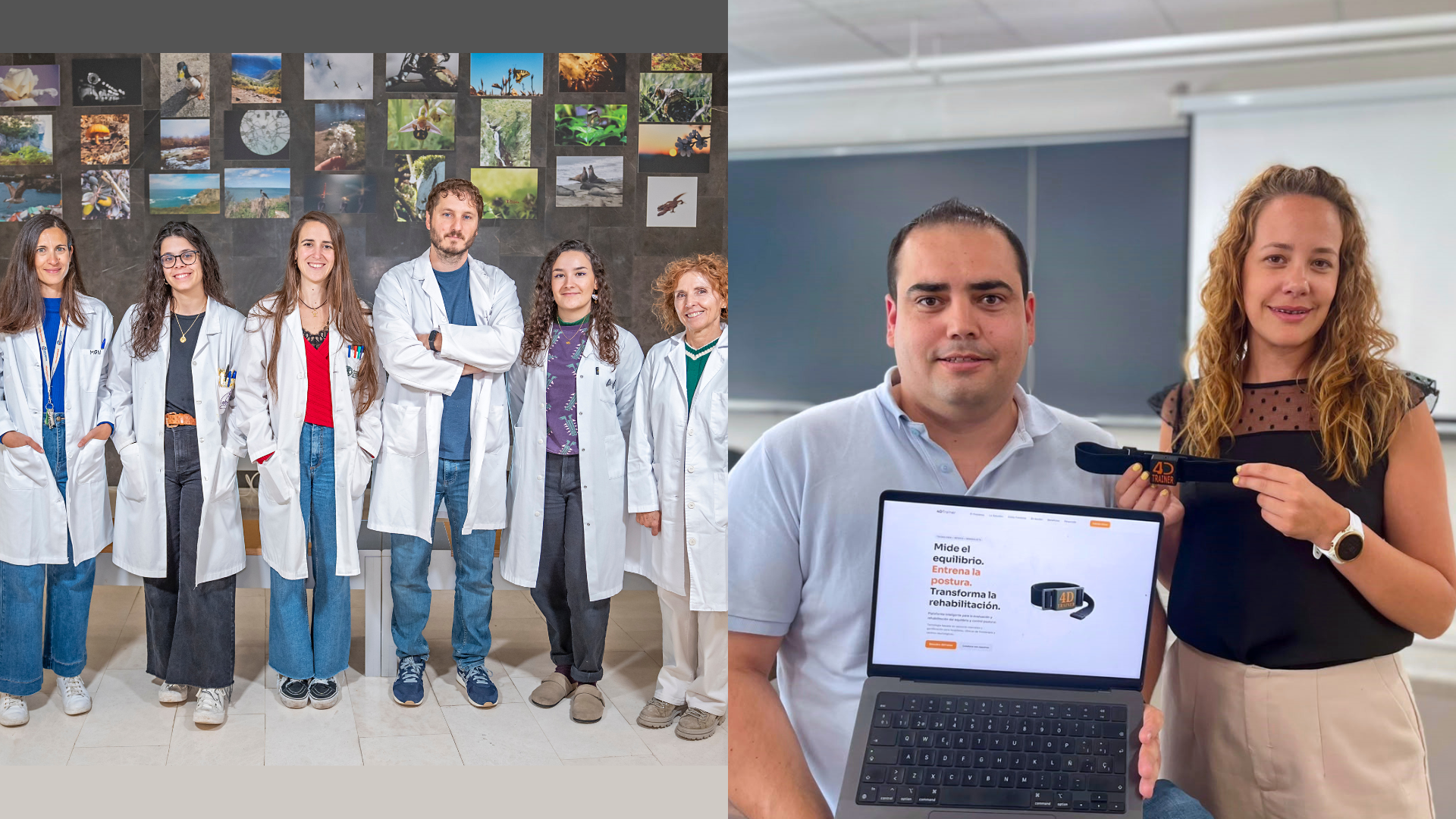
The MSC-ENG project, led by Miguel Pericacho Bustos, a researcher at IBSAL and professor at USAL, is developing an advanced cell therapy to treat hereditary hemorrhagic telangiectasia, a rare disease for which there are currently no effective curative treatments.
4D-Trainer, led by IBSAL researcher and USAL professor Fátima Pérez Robledo and USAL professor André Sales Mendes, utilizes sensor-based technology and virtual reality to objectively assess and train cervical motor control, thereby improving the diagnosis and rehabilitation of a wide range of conditions.
Two projects developed by researchers at the Salamanca Biomedical Research Institute (IBSAL) and professors at the University of Salamanca (USAL) have been awarded the ITEMAS 2026 Quality Seal, an award granted by the Platform for the Promotion and Innovation of Industrial Capacities within the National Health System (ITEMAS) of the Carlos III Health Institute (ISCIII), to which IBSAL belongs. This platform recognizes health innovation initiatives that stand out for their quality, level of maturity, and potential for transfer to the National Health System.
The recognized projects are MSC-ENG, led by researcher Miguel Pericacho Bustos, and 4D-Trainer, coordinated by researcher Fátima Pérez Robledo and computer engineer André Sales Mendes. In addition to endorsing the scientific excellence and innovative potential of both initiatives, the ITEMAS Seal of Quality facilitates access to specialized services for technology transfer support, strategic advice, and recommendations to foster their development and future implementation in the healthcare system.
The IBSAL’s Innovation and Healthcare Products Platform (I.T.SAL) has supported the research teams throughout the process of preparing and submitting their applications, reinforcing its commitment to the commercialization of research results and the transfer of knowledge.
This recognition solidifies IBSAL’s role as a leader in biomedical innovation and highlights the institution’s commitment to knowledge transfer and the development of innovative solutions that help improve healthcare and accelerate the delivery of innovation to patients.
New Cell Therapy to Combat a Rare Disease for Which There Is No Cure
The MSC-ENG project (Mesenchymal Stem Cells – Endoglin) is developing an advanced cell therapy based on mesenchymal stem cells from healthy donors to correct pathological angiogenesis—that is, the abnormal formation of blood vessels characteristic of hereditary hemorrhagic telangiectasia (HHT). This rare genetic disorder causes fragile blood vessels and vascular malformations that can lead to frequent bleeding and other serious complications, and there are currently no effective curative treatments available.
Although mesenchymal stem cells are already used to treat various diseases due to their ability to regulate inflammation, the IBSAL team has discovered a new role for the protein endoglin (CD105). “It acts as a switch that regulates how mesenchymal stem cells behave when used to modulate angiogenesis,” explains Miguel Pericacho. This finding makes it possible, for the first time, to consider selecting or modifying these cells based on their endoglin levels to develop more precise and personalized treatments.
“It’s an approach that didn’t exist until now,” notes the researcher, who emphasizes that this strategy could not only benefit patients with hereditary hemorrhagic telangiectasia but also open up new possibilities for other diseases that involve abnormalities in blood vessel formation.
The results obtained so far are encouraging. In animal models, the treatment has succeeded in reducing the frequency and severity of vascular malformations. “The most immediate goal is to offer a new treatment option for hereditary hemorrhagic telangiectasia, a rare and chronic disease for which there are currently very few therapeutic options,” says Pericacho.
The next step will be to optimize the protocol to turn this strategy into a standardized cell therapy product and complete the necessary preclinical studies before initiating clinical trials in humans. At the same time, the team is working with the I.T.SAL platform to foster collaboration with biotechnology and pharmaceutical companies that will help bring this innovation into clinical practice.
Regarding the recognition received, Pericacho believes that the ITEMAS Seal of Quality “validates, through an external and specialized organization, that our research has a real path toward clinical application.” He also notes that it will help raise the project’s profile and make it easier to secure funding and industrial partners to continue moving forward.
A tool for objectively assessing and training cervical movement
The second project to receive an award, 4D-Trainer, is led by researcher Fátima Pérez Robledo and computer engineer André Sales Mendes. Its goal is to develop a technological tool capable of objectively assessing cervical motor control and using that information to personalize patient rehabilitation.
The system is based on an inertial sensor that accurately tracks head and neck movements while the patient performs various visual tracking tasks within a virtual reality environment. The technology analyzes parameters such as accuracy, speed, coordination, and movement control, and provides immediate feedback during the exercises.
“Its main contribution is that it transforms an assessment that typically relies on clinical observation into an objective, quantifiable, and reproducible measure,” explains Pérez Robledo. In addition to assessment, the device itself allows patients to train through interactive exercises, enabling a more personalized and motivating rehabilitation process.
The potential applications are very broad. The tool could benefit people with neck pain, whiplash, vertigo, vestibular disorders, headaches of cervical origin, or balance disorders, as well as neurological patients who have suffered a stroke or have Parkinson’s disease.
As the researcher points out, “an objective assessment makes it possible to detect deficits that are sometimes not evident during a conventional examination and to accurately monitor the patient’s progress.” The team’s initial studies also point to new diagnostic possibilities. “We have found that cervical motor control is altered before anxiety symptoms are present,” she says, a finding that could pave the way for detecting certain conditions before their clinical manifestations become evident.
Currently, the project has a fully functional prototype that has yielded very promising results in both pilot studies and initial clinical applications. The next steps involve validating the technology in a larger number of patients and conditions, optimizing the software to facilitate its integration into daily clinical practice, and advancing the technology transfer process so that it can be implemented in hospitals, clinics, and rehabilitation centers.
For Pérez Robledo, the ITEMAS Quality Seal represents “a very important recognition of the project’s innovative potential” and confirms that the technology “has the real capacity to make an impact on the healthcare system and be implemented in clinical practice.” Furthermore, he believes that this endorsement will foster new opportunities for collaboration, funding, and technology transfer to bring innovation to healthcare professionals and patients.
IBSAL
The Salamanca Institute for Biomedical Research (IBSAL) was established on March 21, 2011, through an agreement signed by the Department of Health of the Regional Government of Castile and León and the University of Salamanca, which was joined in February 2012 by the Spanish National Research Council (CSIC). It is one of the 36 health research institutes accredited by the Carlos III Health Institute.
Its scientific activity is organized into six areas, comprising a total of 86 research groups: Cancer (22 groups); Cardiovascular, Renal, and Respiratory (11); Neuroscience (12); Infectious, Inflammatory, and Metabolic Diseases (19); Gene and Cell Therapy and Transplants (6); and Primary Care, Public Health, and Pharmacology (16).
For more information and contact details:
comunicacion@ibsal.es