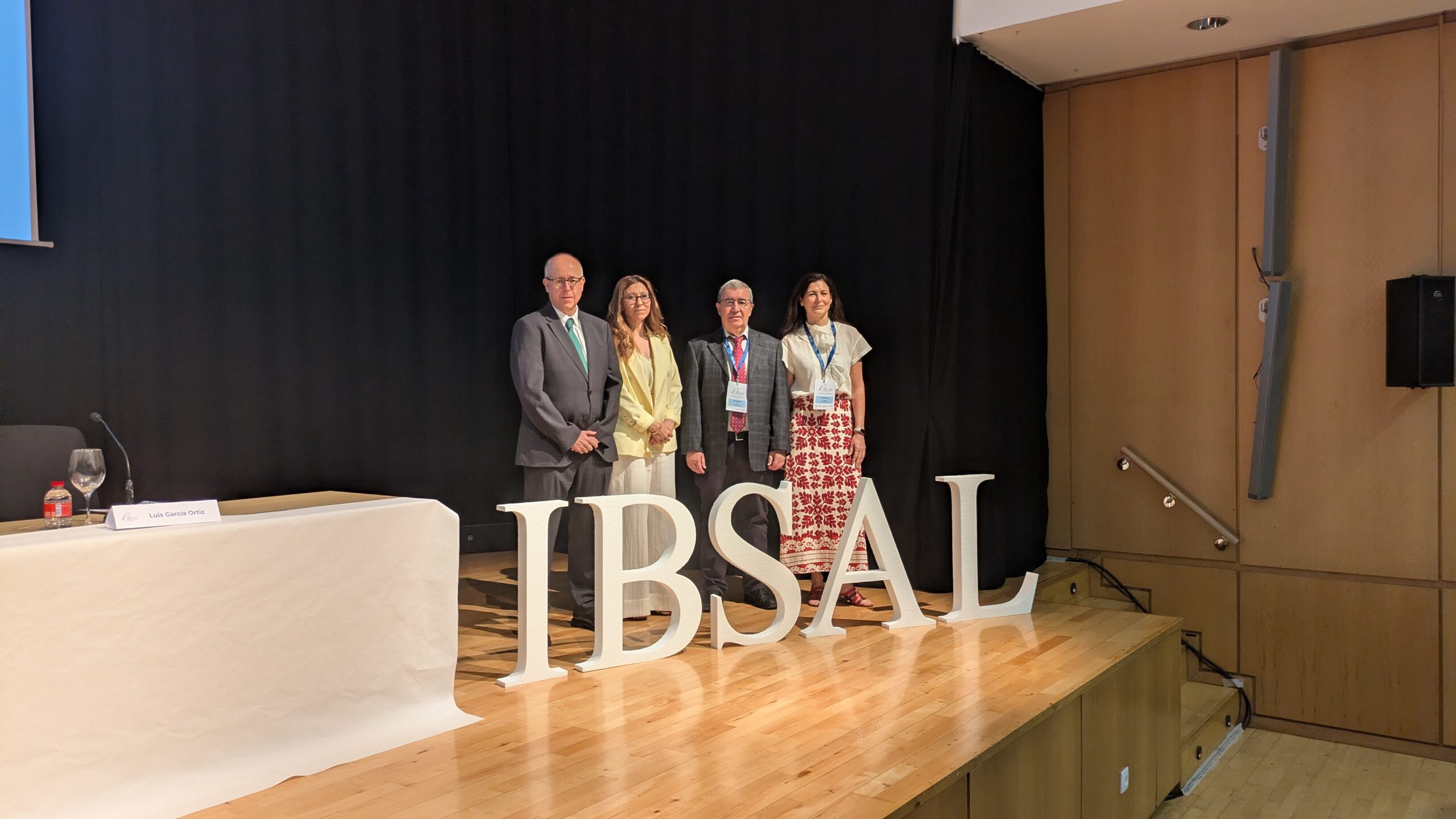
The 5th Scientific Conference brought together young talent, cutting-edge healthcare, and citizen participation through three thematic sessions. This comprehensive event provided an opportunity to review the institution’s major milestones alongside its three scientific directors and to outline its upcoming challenges.
The Salamanca Biomedical Research Institute (IBSAL) held the main event of its 5th Scientific Conference on Wednesday, coinciding with the 15th anniversary of its founding. During the event, the Institute took stock of its history, which has established it as one of the leading centers for biomedical research in Spain.
The official inauguration was attended by the scientific director of IBSAL, Luis García Ortiz; the vice rector for Research at the University of Salamanca, José Miguel Mateos Roco; Sonia Martín Pérez, Director General of Health Planning, Research, and Innovation for the Regional Government of Castile and León; and Raquel Yotti Álvarez, PERTE Commissioner for Cutting-Edge Health at the Ministry of Science, Innovation, and Universities .
During their remarks, the institutional representatives all highlighted the growth IBSAL has experienced since its creation and its role as a driving force behind biomedical research in Salamanca and Castile and León.
IBSAL’s 15 Years Through the Eyes of Its Directors
One of the highlights of the day was the roundtable discussion dedicated to reviewing IBSAL’s 15-year history, featuring its three scientific directors: Jesús F. San Miguel (2011–2013), who spearheaded the Institute’s creation; Rogelio González Sarmiento (2013–2023), who was responsible for its consolidation over the course of a decade; and the current scientific director, Luis García Ortiz (2023–present).
Moderated by IBSAL’s deputy scientific director, Ángeles Almeida Parra, the discussion provided an overview of the Institute’s evolution from its very beginnings. San Miguel argued that research should become a central component of hospital operations.
For his part, Rogelio González Sarmiento emphasized that “the important thing was that IBSAL belong to everyone.”
Luis García Ortiz highlighted the completion of the new IBSAL-specific foundation and the strengthening of citizen participation in research.
The roundtable concluded with a collective acknowledgment of those who have helped build the Institute over the past fifteen years: Ángeles Almeida and Miguel Marcos in its early days, and the management unit and its director, Raquel Carnicero.
Cutting-Edge Healthcare and Strategic Projects
The event also included a panel discussion on the PERTE for Cutting-Edge Healthcare, moderated by Raquel Yotti, with the participation of Marina Pollán Santamaría, Director General of the Carlos III Health Institute, and Álvaro Muñoz Galindo, Director General of Quality and Infrastructure at the Castilla y León Regional Health Authority.
During the meeting, they analyzed the impact of these Strategic Projects for Economic Recovery and Transformation in areas such as personalized precision medicine, advanced therapies, clinical trials, digital transformation, and the modernization of healthcare infrastructure.
Subsequently, researchers from IBSAL presented some of the most innovative projects currently underway in Salamanca as part of the “Salud de Vanguardia” initiative. María Isidoro García discussed the implementation of pharmacogenetics in mental and cardiovascular health; Ángeles Almeida Parra presented the MedPer project for the early detection of cognitive decline; María Díez Campelo outlined the UMBRELLA-SUMMA Legacy initiative on myelodysplastic syndromes; Fermín Sánchez-Guijo explained the progress made by RICORS TERAV+ and the CERTERA Consortium in advanced therapies; while Fernando Martín Lara presented a solution for the stabilization and preservation of biospecimens developed by the Salamanca-based company 300K Solutions.
IBSAL is committed to young talent and civic engagement
The 5th IBSAL Scientific Conference included a Pre-Doctoral Session and a Public Session.
The first event focused on the next generation of researchers, featuring a presentation on scientific success, a roundtable discussion on career prospects after earning a Ph.D., and hands-on workshops focused on artificial intelligence, science outreach, conference presentations, and crafting academic résumés.
Citizens’ Day, for its part, embodied IBSAL’s commitment to promoting open science that is closely connected to society. The event put the spotlight on citizens and, more specifically, on civic associations.
Fundaneed, AFIBROSAL, LGTB+ Iguales, ASPACE, Retina Salamanca, and ASDACE presented the outreach activities they carried out in collaboration with the institute in 2025.
In this way, IBSAL is reinforcing its commitment to science that is more open, participatory, and connected to society.
IBSAL
The Salamanca Institute for Biomedical Research (IBSAL) was established on March 21, 2011, through an agreement signed by the Department of Health of the Regional Government of Castile and León and the University of Salamanca, which was joined in February 2012 by the Spanish National Research Council (CSIC). It is one of the 36 health research institutes accredited by the Carlos III Health Institute.
Its scientific activity is organized into six areas, comprising a total of 86 research groups: Cancer (22 groups); Cardiovascular, Renal, and Respiratory (11); Neuroscience (12); Infectious, Inflammatory, and Metabolic Diseases (19); Gene and Cell Therapy and Transplants (6); and Primary Care, Public Health, and Pharmacology (16).
For more information and contact details:
comunicacion@ibsal.es